
Research Bulletin

 |
 |
 |
|
Sustainable Strategies for Net Zero: An Asia Pacific Perspective The journey toward net zero emissions in Asia requires collective action, innovation, and commitment from governments, businesses, and communities to pave the way toward a brighter and greener future.
|
Unraveling the Impact of Financial Literacy on Investment Decisions in an Emerging Market The financial literates have a greater likelihood of making informed investment decisions.
|
Impact of Green Banking Practices on the Environmental Performance of Banks: The Mediating Role of Green Financing in Sri Lanka The study highlights that green finance partially mediates the relationship between green banking practices (GBPs) and environmental performance (EP) in Sri Lanka.
|
 |
 |
 |
|
The Sources of Stock Market Volatility: A Study on the Colombo Stock Exchange The findings revealed that internal/own and external shocks substantially impact the stock price volatility in CSE. Significant volatility clusters and persistence with extended memory in ASPI confirm internal/own shock in the market.
|
Impact of Mobile Money Adoption on Financial Inclusion in Sri Lanka: Mediating Impact of Hedonism There is a significant relationship between mobile money adoption and financial inclusion which is mediated by hedonism, in SMEs in Sri Lanka.
|
Community Perception on Tourism Development: A Case Study of Riverston, Matale, Sri Lanka. Strategies for overcoming the challenges of undesirable community perception on tourism development.
|
 |
 |
 |
|
Ayurveda Wellness Tourism (AWT): An Overview of the Sri Lankan Context The results suggest that Sri Lankan AWT requires long-, mid-, and short-term-based corrective actions, and introducing and increasing awareness of sustainable tourism products are recommended to further sustainable hospitality and tourism management in Sri Lanka.
|
Challenges and Strategies of Ayurveda-Related Wellness Tourism Sustainability in Sri Lanka. Based on the findings of the study, the researcher has formulated several recommendations. Proposing government universities to include AWT and the use of indigenous medicinal practices in the wellness sector as an academic discipline, was one of the recommendations through which, a solid foundation is sought for future developments.
|
Exploring the Effects of Service Innovation Ambidexterity on Service Design in the Tourism and Hospitality Industry Entrepreneurial strategy fosters innovation exploration and exploitation, with exploitation enhancing unique services that secure lasting competitive advantage and performance in tourism and hospitality firms.
|
 |
 |
 |
|
How Knowledge-Spillover Entrepreneurship Influences the Adoption of Social Media and Customer Relationship Management Knowledge spillover via entrepreneurial orientation boosts firm performance, with social media mediating and environmental turbulence and CRM moderating its impact in dynamic markets.
|
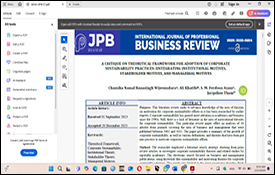
A Critique on Theoretical Framework for Adoption of Corporate Sustainability Practices: Integrating Institutional Motives, Stakeholder Motives, and Managerial Motives We believe that despite the similarities and connections between the three theories: institutional theory, stakeholder theory, and managerial motives, they are complementary rather than competing.
|
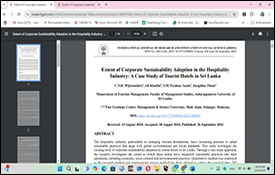
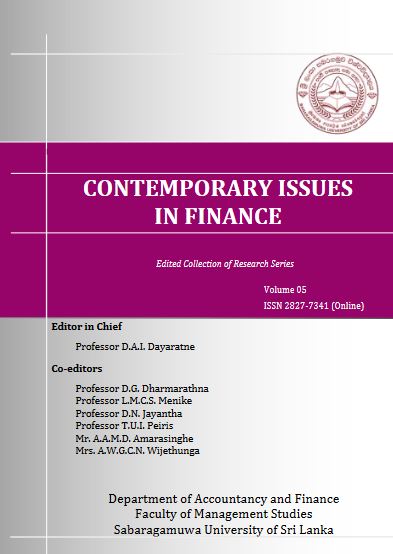
Extent of Corporate Sustainability Adoption in the Hospitality Industry: A Case Study of Tourist Hotels in Sri Lanka The dominance of environmental practices in the sustainability efforts of Sri Lanka’s tourist hotels underscores the sector’s commitment to addressing ecological concerns while socio-cultural and economic aspects remain lack of attention from the hotel management.
|
 |
 |
 |
|
Factors Affecting Innovation: A Study of the Sri Lanka Police Limited physical resources, restrictive decision-making freedom, and inadequate feedback mechanisms are the challenges and political interference, outdated legal frameworks, and insufficient training opportunities emerged as barriers to innovation.
|
Differential Value Relevance of Accounting Information on Investors' Decisions: Evidence from Sri Lankan Commercial Banks Strong positive correlation between NAVPS and MVPS during non-crisis periods, while EY was negatively associated with MVPS. In the crisis period, EY had a negative link to MVPS, and EPS showed a positive relationship.
|
Green Banking Practices and Sustainability Performance of Commercial Banks in Rathnapura District in Sri Lanka Employee-related practices, daily operation-related practices, and bank policy-related practices have positive and significant impacts on the bank’s sustainability performance while customer-related practice was not a significant.
|
 |
 |
 |
|
Book Review on the Routledge Handbook of Hospitality Marketing, edited by Dogan Gursoy, 2018, Routledge. The book provides readers with essential skills to help them succeed in hospitality marketing by examining historical context and modern approaches alongside future obstacles.
|
Book review: Marketing 6.0: the future is immersive
Co-creation and immersive technologies are essential for engaging hyper-connected consumers, redefining traditional marketing boundaries and fostering meaningful, value-driven brand relationships.
|
Environmental impact of financial Market's development in Australia
Market-based financial development improves long-term environmental quality while the short-run impact opposes the long-run outcome in Australia.
|


 |
 |
 |
|
Moderator effect of technological advancement on financial development and economic growth nexus in Asian countries Technology is a crucial moderator to achieving sustainable development with Financial Development
|
Managerial conception of integrating sustainability into management control systems: evidence from Sri Lankan manufacturing companies What drives companies to integrate Sustainability into Management Control Systems- Managerial Perception.
|
The effects of enterprises' attention to digital economy on innovation and cost control: Evidence from A-stock market of China Promoting Innovation and the Digital Economy
|
 |
 |
|
|
Effects of resource orchestration, strategic information exchange capabilities, and digital orientation on innovation and performance of hotel supply chains Balancing IT and resource orchestration capabilities for improving supply chain innovation and performance.
|
Medicine in Sri Lanka: Selection of healing rituals to cure health issues The supernatural healing systems encompass ritual and magical practices rooted in classical knowledge and religious traditions.
|
Issues and challenges related to ayurveda wellness tourism development in Sri Lanka: The perspective of ayurveda health professionals.
|
|
 |
 |
|
Employees’ attitudes and the quality of the ayurvedic drug manufacturing processes The study findings suggest that higher levels of job satisfaction and job involvement are associated with improved process quality in Ayurveda drug manufacturing.
|
Antecedents and challenges of sustainable event management practices in Sri Lanka Strategies for overcoming the challenges of sustainable event management practices in Sri Lanka.
|
Harmonizing luxury and sustainability: potential of developing luxury sustainable tourism in Sri Lanka from hoteliers’ perspective Combining luxury and sustainability in the hospitality sector.
|
 |
 |
 |
|
A critique on theoretical framework for adoption of corporate sustainability practices: integrating institutional motives, stakeholder motives, and managerial motives. Developing a theoretical framework for corporate sustainability adoption of a business organization.
|
The role of shopping values, cognitive and affective evaluations on the relationship between store environment and store patronage intention: a future research agenda Unveiling the impact of shopping values, cognitive and affective evaluations on patronage intention in modern retail.
|
Impact of perceived risk on female consumers’ online purchase intention: empirical evidence from online apparel retail market in western province in Sri Lanka Risk Perception in Online Apparel Shopping: Insights from Western Province, Sri Lanka.
|
 |
 |
 |
|
Reasons for undergraduates’ attitudes toward online learning University students exhibit a range of attitudes towards online learning, swayed by various influences, yet many rally behind it in times of crisis.
|
Exploring digital agility and digital transformation leadership: a mixed method study Digital Agility and Digital Transformation Leadership.
|
Financial development and environmental quality in developed countries: a systematic literature review Financial Development’s Impact on Environmental Quality.
|
 |
||
|
The effect of financial development on environmental quality: a developing country evidence Financial Development and Environmental Quality: Insights from Sri Lanka.
|


|
|
|
 |
Motives of mobile payment adoption during COVID-19 pandemicMotives of mobile payment adoption during the COVID-19 pandemic in Sri Lanka..
|
Fusion of Artificial Intelligence and Blockchain in the Banking Industry: Current Application, Adoption, and Future ChallengesFusion of Artificial Intelligence and Blockchain in the Banking Industry
|
Exploring the challenges in developing and managing digital agility among Sri Lankan family business owners during the economic crisis situationManaging digital agility among Sri Lankan family business owners during the economic crisis situation
|
 |
 |
 |
Food acquisition and consumption issues of South Asian countries: a systematic literature review and future research agendaFood acquisition and consumption issues of South Asian countries
|
Persistent Fiscal Deficit as a Determinant of Inflation in Sri Lanka: An ARDL ApproachPersistent Fiscal Deficit as a Determinant of Inflation in Sri Lanka
|
The Role of Health-Related Perceptions on Mobile Payment Adoption: Evidence from the Mobile Banking Industry in Sri LankaThe Role of Health-Related Perceptions on Mobile Payment Adoption in Sri Lanka
|
 |
 |
 |
Insurance Penetration and Institutional Spillover on Economic Growth: A Dynamic Spatial Econometric Approach on the Asian and Europe RegionInsurance Penetration and Institutional Spillover on Economic Growth
|
Luxury Marketing and Sustainability in the South Asian ContextLuxury Marketing and Sustainability in the South Asian Context
|
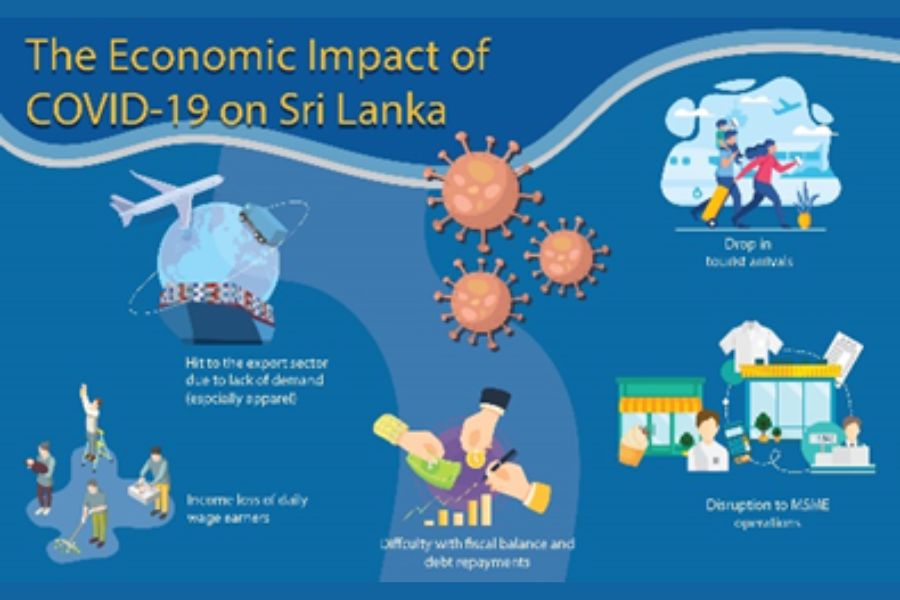
How Has COVID-19 Impacted the Business Performance of Sri Lankan Firms: A Qualitative InquiryHow Has COVID-19 Impacted the Business Performance of Sri Lankan Firms
|
 |
 |
 |
Financial Soundness of General Insurance Industry in Sri Lanka: A CARAMELS ApproachFinancial Soundness of General Insurance Industry in Sri Lanka:
|
Financial Services Employee Engagement and Attitude Toward Artificial Intelligence: Evidence From Sri LankaExploring Digital Agility and Digital Transformation Leadership
|
Preventive Strategies to Reduce Musculoskeletal Disorders of Nursing Personnel; A Systematic Review: Musculoskeletal Disorders of Nursing PersonnelPreventive Strategies to Reduce Musculoskeletal Disorders of Nursing Personnel;
|



|
|
|
 |
|
Assessing the sustainability performance of social practices in manufacturing supply chains Examine the impact of social practices adopted by the apparel industry on sustainable performance.
|
Impact of COVID-19 Pandemic on the Tourism Industry in Sri Lanka: The Dilemmas of Industry Sustainability Resilience Strategies for sustaining tourism business during and after the post-pandemic situation.
|
Connecting the Connected: How Is Sri Lanka Prepared to Respond to Digital Tourists? Preparedness of Sri Lanka as a smart tourism destination to cater the digital tourists.
|
 |
 |
 |
|
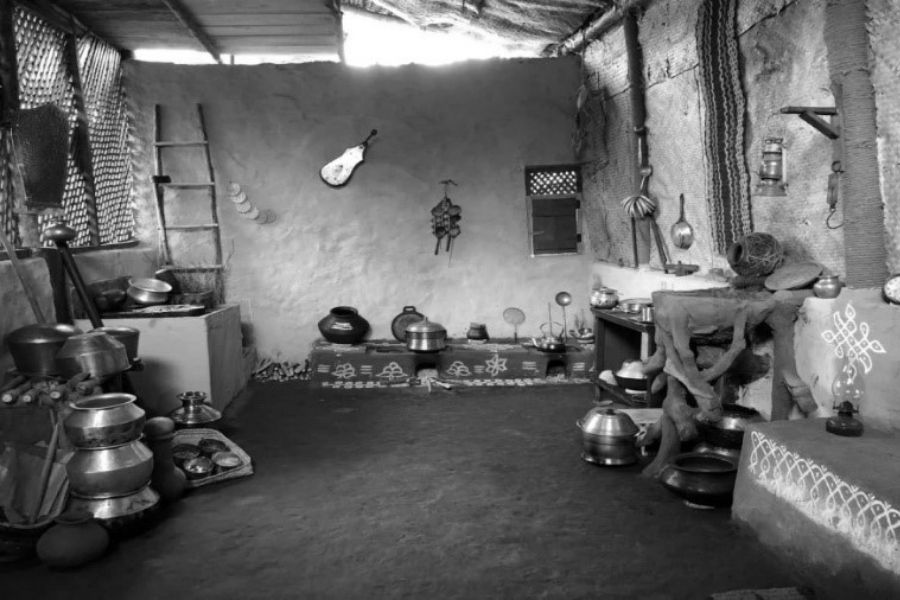
Line Rooms: Authentic Approach to Heritage Tourism Exploring upcountry tea pickers' culture and their lifestyles which are so culturally vibrant and socially sentimental.
|
Hospitality and Tea: Taking Tea Culture to the Next Level How Sri Lankan hoteliers taking tea culture to the next level?
|
Information Technology and Its Challenges Towards Sri Lankan Event Tourism: Event Managers’ Perspective Challenges of the adaptation of information technology in Sri Lankan event tourism.
|
 |
 |
 |
|
Book Review: Tourism Management, Marketing, and Development edited by Mariani, M. M., Czakon, W., Buhalis, D., & Vitouladiti, O. (Palgrave Macmillan; 1st Edition (2016); Pages: 291) The performance and strategies at the destination and advances in management practices in the tourism sector.
|
Domestic Millennial Tourists’ Attitudes & Beliefs Towards Green Hotels Practices of Green Certified Hotels in Sri Lanka. The application of authentic eco-tourism concept in a futuristic world.
|
Study on The Potential of Developing Medical Tourism in Sri Lanka with Special Reference to the Major Private Hospitals in Sri Lanka Focusing Medical tourism in Sri Lanka as an emerging concept in Tourism.
|
 |
 |
 |
|
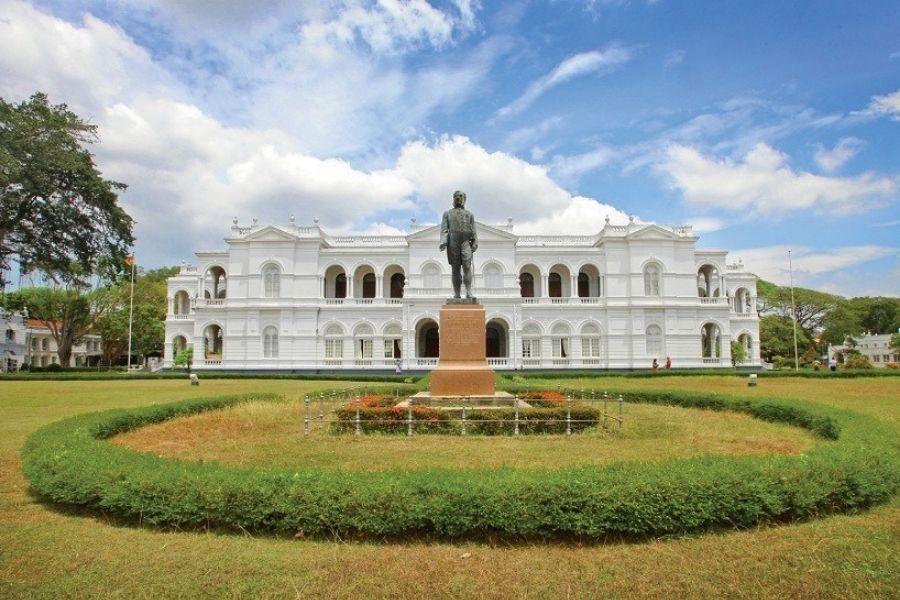
Museum Visitor Experience in Sri Lanka The level of museum visitor experience and how it affects tourists’ satisfaction, recommendation and revisit intention.
|
Corporate social responsibility and dividend policy in Sri Lankan firms: A data triangulation approach The generosity of the management leads to shareholders' prosperity.
|
Interdependent Trading Behavior of Foreign and Local Investors: Evidence from the Colombo Stock Exchange Interdependent Trading Behavior of Foreign and Local Investors.
|
 |
 |
 |
|
Motives of mobile payment adoption during COVID-19 pandemic in Sri Lanka: a holistic approach of both customers' and retailers' perspectives Motives of mobile payment adoption during the COVID-19 pandemic.
|
Health-related Behavior and Adoption of Mobile Payments in Life Insurance During the Pandemic: Evidence from Sri Lanka Health-related Behavior and Adoption of Mobile Payments in Life Insurance During the Pandemic.
|
Perceived Security Risk, Perceived Privacy Risk, and Perceived Trust of Mobile Payment Adopters and Non-Adopters: Impact of the COVID-19 Pandemic Perceived Security Risk, Perceived Privacy Risk, and Perceived Trust of Mobile Payment Adopters and Non-Adopters.
|
 |
 |
 |
|
Demystifying research culture in universities Demystifying research culture in universities
|
Identified research gaps in the literature of employee engagement: a study of the military context Employee engagement in the military context
|
The Dividend Decision Model: A Possible Solution for the Dividend Puzzle Introduction of the Dividend Decision Model as a solution for the dividend puzzle.
|
 |
 |
 |
|
Is South Asia ready for the next universe–metaverse? Arguments and suggestions for further research The readiness for the next universe: Metaverse
|
Supply-driven Factors of Inflation in Sri Lanka: An ARDL Approach Supply-driven Factors of Inflation in Sri Lanka
|
A multi-layer organizational culture framework for enhancing the financial performance in tourism and hospitality family firms A multi-layer organizational culture framework for tourism and hospitality family firms.
|
 |
 |
 |
|
Sponsored-influencer marketing: effects of the commercial orientation of influencer-created content on followers’ willingness to search for information How does sponsored influencer marketing on Instagram stimulate followers’ willingness to search for information?
|
Impact of diversity management on innovative work behavior: mediating role of human resource management and affective commitment Does diversity management foster innovative work behavior?
|
Impact of Forensic Accounting Knowledge on Fraud Detection: With Special Reference to Sri Lankan Context The skills which forgers use to conduct fraud are hard to reveal.
|
|
|
|
|
|
Is South Asia ready for the next universe–metaverse? Arguments and suggestions for further research Hospitality exists even beyond the commercial domain
|
Telecommuting and Creativity of Professional Employees in Software Developing Industry in Sri Lanka How does telecommuting flourish and languish creativity?
|
Book Review: Glass Half Broken: Shattering the Barriers that Still Hold Women Back at Work, Colleen Ammerman and Boris Groysberg (Harvard Business Review Press, 1 st Edition (2021), Pages: 294). Is Glass Ceiling Still prevalent and how to shatter it?
|


Message From The Dean

I am delighted to present the inaugural issue of our Faculty of Management Studies (FMS) Research Bulletin. As academics, research remains one of the most important contributions we make to the world. This publication showcases the diversity and quality of research conducted by our faculty members and highlights the many ways in which they advance modes of thinking, knowledge, and practice. Our researchers are highly engaged in our community, and I am proud of their dedication to rigorous and influential research that positively impacts our country and the world.
The Faculty of Management Studies is accredited as an “A” graded Faculty by the Quality Assurance Council of the University Grants Commission recently, with “A” grades for all its degree programmes. Being a state university and a consumer of public funds, we are highly conscious of academic excellence. The faculty is dedicated to pursuing an excellent teaching and research culture to deliver high-quality education in a picturesque and peaceful environment for our students and all other stakeholders. Identifying our academic responsibilities, this bulletin is intended as a step towards developing our community’s awareness of the quality and quantity of excellent research. Our researchers publish in top journals and explore a wide breadth of topics, as you will see herein. The primary goal of this bulletin speaks to fostering an environment that will inspire research excellence and train the next generation of scholars.
The past few years have continued to be challenging with the Covid-19 pandemic and economic crisis. As these issues persist, some of our researchers are putting their expertise to good use by examining their impact and identifying solutions to help the country and world move forward. Through a pragmatic and conscientious approach to research and by cultivating strategic partnerships, we aim to design an ecosystem that pursues, supports, and celebrates research that makes a difference.
I am very pleased to see the breadth of impactful research profiled in the pages of this bulletin, and I congratulate each contributor for their accomplishments. Further, I would like to extend my sincere appreciation to our many partners and stakeholders whose support makes our research activities possible. Collectively, we are committed to making an impact in the South Asian region and beyond for the better.
Prof. (Dr.) Athula Gnanapala
Dean
Faculty of Management Studies
Sabaragamuwa University of Sri Lanka
Message From The Chairman

Welcome to the first edition of the FMS Research Bulletin! This research bulletin showcases the diversity and quality of research conducted by our faculty members, and highlights the many ways in which they advance research and knowledge dissemination on modes of thinking, knowledge and practice. Our members are highly engaged in many innovative researches in diverse fields and I am proud of their dedication to rigorous and influential research that positively impacts their specific discipline, country and the world. The purpose behind research at the Faculty of Management Studies, the reason for enabling the transformation of our world through inspiration, innovation and integration. Through a pragmatic and conscientious approach to research, by cultivating strategic partnerships and by aligning ourselves with development-oriented research, we aim to design an ecosystem that pursues, supports and celebrates research that makes a difference. The ever-changing business landscape offers infinite research possibilities, and the ways in which we can make an impact are limitless. I would like to express my thanks and admiration to the editor-in-chief, the editorial team of the research bulletin and all of our researchers who continue to do excellent work, and to our many funders and partners whose support makes our research activity possible. With your dedication and dissemination of knowledge, we are able to continue transforming our world for a sustainable future.
Sincerely
Professor (Dr) M.S.M. Aslam
Chairman Research and Publication Unit/Faculty of Management Studies
Message From The Editor In Chief

Knowledge dissemination is a core responsibility of researchers. In today's fast-paced world, numerous online and paper-based journals devoted to management studies are published globally. The academics of the Faculty of Management Studies at the Sabaragamuwa University of Sri Lanka significantly contribute to these scientific publications. In recognition of these contributions, the Research and Publication Unit of the Faculty of Management Studies is proud to present the latest issue of the FMS Research Bulletin. This bulletin summarizes key findings from research articles published in leading scientometric databases and provides convenient links to the respective journals or publications for easy reference.
The FMS Research Bulletin is published bi-annually and serves as an open platform for readers to track and evaluate emerging research topics in the field of management. It provides a space not only for eminent scientists but also for young academics just beginning their research careers, contributing to the global knowledge system.
I extend my special appreciation to the editorial board and the authors for their commitment and for submitting their research details for inclusion in the FMS Research Bulletin. I am confident that this platform will continue to grow and showcase the extreme capabilities and insightful concepts of our academics, bringing their research to the forefront of the world.
Kind regards,
Prof. (Mrs.) L.M.C.S. Menike
Editor-in-Chief, FMS Research Bulletin
Professor
Department of Accountancy and Finance
Faculty of Management Studies
Sabaragamuwa University of Sri Lanka
Editor in Chief – FMS Research Bulletin
Editorial Board
Editor-in-Chief
Prof. L.M.C.S. Menike
Co-Editors
|
Mrs. PLGSD Piumali |
Mr. KC Ariyarathna |
 |
|
| Mrs. W.A.L.M. Bandara | Mrs. S.H.M.L. Walakumbura |


Editorial Advisors
Prof. W.K.A.C. Gnanapala
Prof. M.S.M. Aslam
Graphic Designers
Mr. H.M.M.A. Herath
Mr. K.S.S.N. Karunaratne